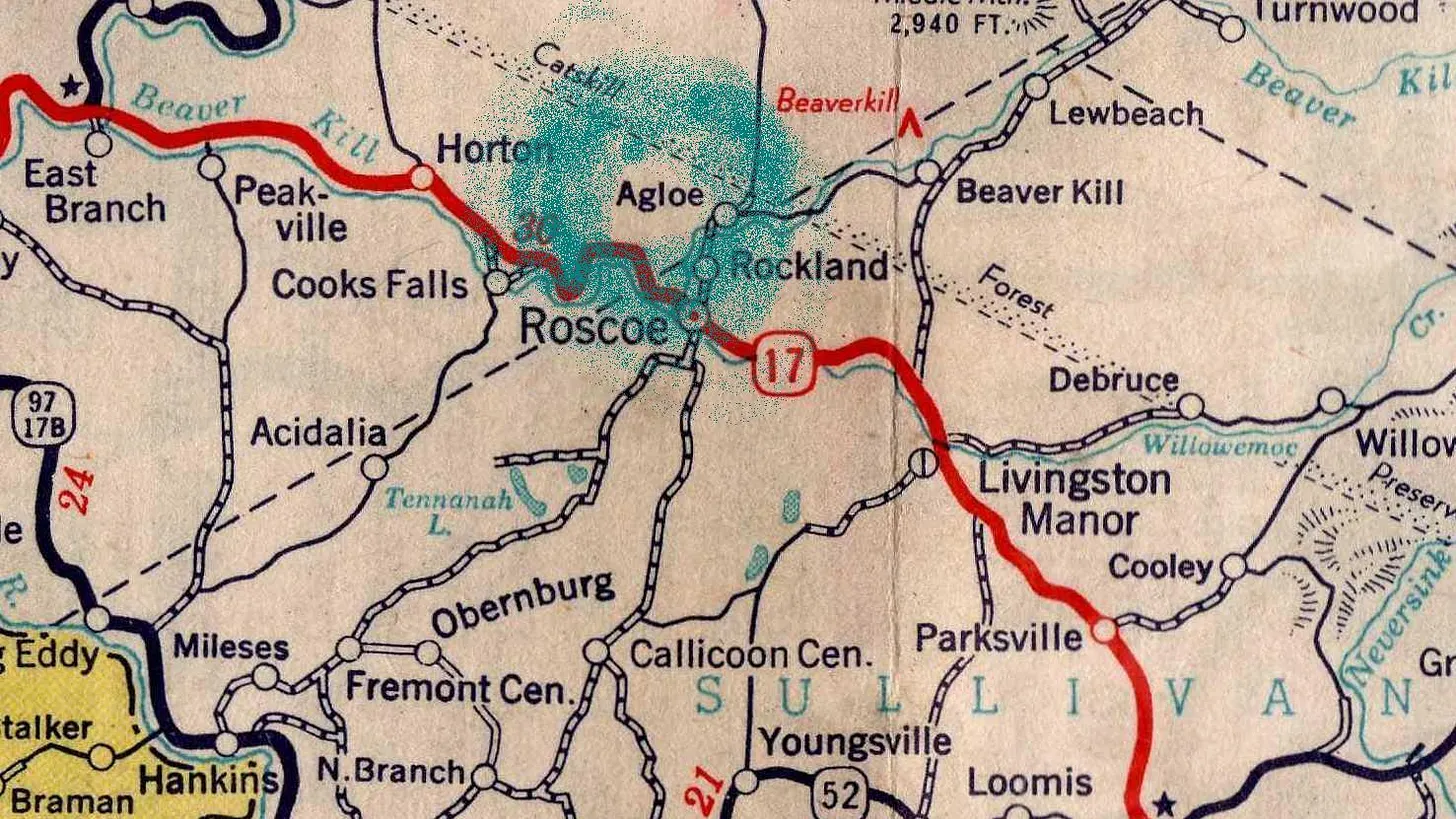
The Agloe Paradox
And the strange power of the maps we draw for ourselves.
We tend to think of maps as the most honest things we make. To give them some credit, that perception is virtually axiomatic to their purpose. A map is, by definition, a representation of what is physically there. It is the opposite of fiction. If there is a mountain on the map, there is a mountain in the world. If there is a blue line, there is a river. We wholeheartedly trust maps because we believe that the place comes first, and the drawing comes second.
But in the 1930s, a company called the General Drafting Corporation showed that sometimes, the drawing comes first, and the place doesn’t even exist.
At the time, making a road map was an agonizingly difficult process. You couldn’t just look at a satellite feed; cartographers had to send men out in cars to drive thousands of miles of dirt roads, taking notes on every turn, every intersection, and every farmhouse. It was expensive, exhausting work. And because it was so hard, mapmakers were terrified of copyright theft. They lived in constant fear that a competitor would simply buy their map, trace it, and sell it as their own without doing any of the driving, inspecting, and charting themselves.
So, the General Drafting Corporation set a trap.
On a map of New York State, at a tiny dirt intersection somewhere in the Catskill Mountains, the company’s founder, Otto G. Lindberg, and his assistant, Ernest Alpers, decided to invent a town. They drew a tiny dot at that intersection, scrambled their initials to create the name “Agloe”, and released their map out into the world.
Agloe, like many other fictional landmarks, was a “paper town”— a copyright trap born out of the sole purpose of catching would-be thieves. If a competitor’s map appeared with the hamlet of Agloe on it, General Drafting would have irrefutable proof of plagiarism.
Decades passed, and in the 1950s, the mapmaking giant Rand McNally released a new atlas of New York. Right there, at that same dirt intersection in the Catskills, was Agloe.
General Drafting was ecstatic, and sued McNally immediately. It was seemingly an open-and-shut case, and there was no conceivable way Rand McNally could have found Agloe unless they had stolen it.
But Rand McNally’s defense was simple, and remains one of my favorite plot twists in legal history. They denied copying the map, and instead pointed to the Delaware County administration records, which showed that a business was legally registered at those exact coordinates under the name Agloe.
As it turns out, the proprietor of a fishing lodge had built a structure at that intersection. When looking for a name for his establishment, he checked an old Esso map distributed by General Drafting. He saw “Agloe” printed over the location, assumed it was the official name of the hamlet, and christened his business the Agloe Lodge. The fiction had become a brick-and-mortar reality.
Paradoxically, the map didn’t describe the world; the world warped to fit the map.
I think about Agloe constantly because it is the perfect metaphor for the strange, shaky architecture of human identity. We love to believe that we “discover” ourselves, as if our personality is some pre-existing continent and we are merely the explorers mapping its coastline. We think, I am an introvert, or I am not a math person, as if these are geological facts waiting to be found.
But I suspect that we are actually doing what Otto Lindberg once did. We are drawing dots on the blank paper of our lives, giving them names, and then hoping that if we stare at them long enough, a building will appear.
There is a philosophical term for this: hyperstition. It’s a portmanteau of “hype” and “superstition”, a fiction that makes itself true. It is the ‘fake it till you make it’ strategy of existence. We draw ourselves a little dot called “Brave” or “Kind” or “Happy,” and we perform the role until the performance calcifies into truth.
But our internal cartography can misguide us as easily as it can create us. If we can build Agloe out of nothing, we can build our own prisons out of nothing, too. We sketch little trap towns in the darker corners of our psyche, and then unconsciously drive to those coordinates. We sabotage relationships or quit jobs just to prove that the map was right. We build the fishing lodge of our own misery just so we can say, “See? I knew this was here all along.”
I love Agloe not because it reminds me that maps are fake, but because it reminds me that maps are powerful. The lines we draw on ourselves— the labels we accept, the stories we tell about who we are and what we are capable of— are not passive descriptions. They are architectural blueprints that turn into reality if believed long enough.
I also find a deeper comfort in the existence of this nonexistent town. Agloe wasn’t just a random collection of letters; it was an anagram of the creators’ names. Otto and Ernest couldn’t help but hide their own identities in the landscape they were drawing. They were supposed to be invisible observers, but they couldn’t resist the urge to sign their work.
Agloe reminds me that nothing human-made can ever be truly perfect, and nothing perfect will ever be human. Not the maps we draw, not the bricks we lay, not the roads we pave. There is always a piece of a person that remains in something, a handprint in the cosmic clay that makes it unique. What began as one cartographer’s selfish copyright trick became a real town with real people. A lie became a home because somebody believed it.
The Agloe Lodge eventually closed. The building fell into disrepair and was demolished. Today, if you go to that intersection in the Catskills, there is nothing there but trees and dirt. The territory reclaimed the fiction.
But for a fleeting moment, this nonexistent town existed simply because two men wrote it down, and a third man believed them.
We have a terrifying amount of control over the reality we inhabit. The pen is constantly in our hand. But this creates a legacy: it means we are never truly gone. Any line we draw, out of love, or fear, or just to catch a thief, will ripple outward in ways we can never conceive. We can draw towns that trap us, or we can draw towns that shelter us. The world is surprisingly malleable. It is simply waiting for us to tell it where the buildings go.